What Quiet Luxury Actually Means in Jewelry
The phrase has been strip-mined by every brand with a blog. But the idea underneath it — what a piece communicates and to whom — is still worth understanding.
Walk through any mid-size jewelry brand’s website right now and count how many times you see the word “timeless.” Then count how many times you see the phrase “quiet luxury.” Then go sit down somewhere quiet, because you’ve earned it.
The phrase has been applied to basically everything that isn’t rhinestones. Gold hoops. Solitaire pendants. Plain bands. Anything clean, anything minimal, anything that could theoretically be worn by someone who summers as a verb. “Quiet luxury” became the catch-all description for a vast swath of fine jewelry, and in doing that it mostly stopped describing anything at all.
Which is a shame, because the idea it was originally reaching for is real and actually useful, especially if you’re trying to build a jewelry collection that looks curated rather than collected-by-accident. The phrase has been strip-mined, but the instinct underneath it is worth salvaging.
What Made It Stick in the First Place
The concept landed because it put a name on something a lot of people already felt. The difference between jewelry that announces itself and jewelry that reveals itself. The piece that makes the whole room look when you walk in versus the piece that makes exactly the right person look, and makes that person think “oh, she knows what she’s doing.”
Stealth wealth was one name for it, though that always sounded more calculated than most people mean. There’s a real aesthetic difference between dressing to project and dressing to express. One is a broadcast. The other is more like a frequency only certain people are tuned to pick up. Quiet luxury, at its most coherent, was always about the second thing.
That idea resonated. Then every jewelry brand with a blog and a marketing calendar figured out the phrase was performing well in search, and the gold rush began. Suddenly any piece that wasn’t covered in logos was “quiet luxury.” Brands that had been selling the same simple chain since 2015 discovered they’d been doing quiet luxury all along, who knew. The phrase stopped being a description of a specific taste decision and became a product category. And a broad one. A $150 gold-plated pendant from a brand that runs 40% off sales every other week can be quiet luxury now. So can a $4,000 hand-finished ring from a designer who makes fifty pieces a year. Once a term can mean both of those things at the same time, it means neither of them.
Broadcast, Narrowcast, and the Gap Between Them
Quiet luxury in jewelry, once you strip away the marketing, was always about one thing: the difference between a piece that communicates to the room and a piece that communicates to a person.
Status and taste in jewelry are tangled up in each other, and that’s uncomfortable territory for brands trying to sell you something. But stay with me for a second.
When you wear an obviously branded piece, say a widely recognized house logo on a pendant or a bracelet with a name everyone knows, you’re broadcasting on a public frequency. Everyone in the room receives the signal. They may not know the exact price but many of them understand the category. And that broadcast has real power. There are rooms where the right brand on your wrist or your neckline is a key that opens a very specific door. Dismissing that as shallow is its own kind of snobbery, and anyone who’s spent time in those rooms knows it. The right Cartier piece in the right meeting communicates something useful, and it communicates it to everyone, which is sometimes exactly what you need.
The quieter version is a narrowcast. A beautifully made ring from a designer who doesn’t advertise much, in a style that takes some knowing to read. To most people in the room it just looks like nice jewelry. To someone who has been paying attention to fine jewelry for a while or is in the design community, it communicates a lot more: that you sought it out rather than walked into the nearest name. That your taste is your own.
That gap between the two readings is where the whole concept lives, and it’s genuinely interesting. It’s also where the economics get weird because those independent designers are usually charging less than the big houses even though the work is often more labor-intensive. There’s a whole conversation to be had about why that is, whether the designers are underpricing themselves out of necessity or choice or just haven’t figured out how to market their work to the people who can actually afford it. Some of them are making pieces that should cost twice what they’re asking, and some of them are making pieces that are worth exactly what they’re asking but happen to have better margins because they’re not funding a global marketing operation and a skyrise in Midtown.
Anyway. What every “quiet luxury” aficionado actually ignores in favor of recommending you buy a thin chain is that the gap exists at all.
Years ago I was attending an event for work. It was for lighting designers from New York City introducing a new product line of full spectrum, fully controllable lighting for museums, high end residences, art galleries. One of the designers there had a remarkable piece on their ear that I remember to this day. It was a crossbar across the widest part of their ear, angled to match their hairline which was shaved short on that side. Then it had a curved shape that perfectly matched the contour of their ear. It was the type of thing where someone who knew would know: that was custom made, or this person is, or is close friends with, a very good jeweler. And the level of detail and intention in that piece made me want to be friends with that person.
The interesting people tend to work both channels. Cartier studs to the board meeting, a one-of-a-kind artisan cuff to dinner.
The broadcast certainly has its place and I’ve seen it open doors more often than not. But if the narrowcast is where your interest lies, you can often find something better made, more distinctive, and less marked up by looking past the big houses at independent designers who put the budget into the piece rather than the campaign.
Restraint matters too. The piece that was actually edited down to what it needed to be, not what was trendy, plays different over time. You notice the difference between a chain length that was chosen and a chain length that was just standard.
One Piece Is Not a Look
Quiet luxury content almost always falls apart in the same place. It acts like buying one good piece is the whole game. Buy a simple gold chain, you’re done, you’ve achieved the aesthetic. No. You’ve bought a chain.
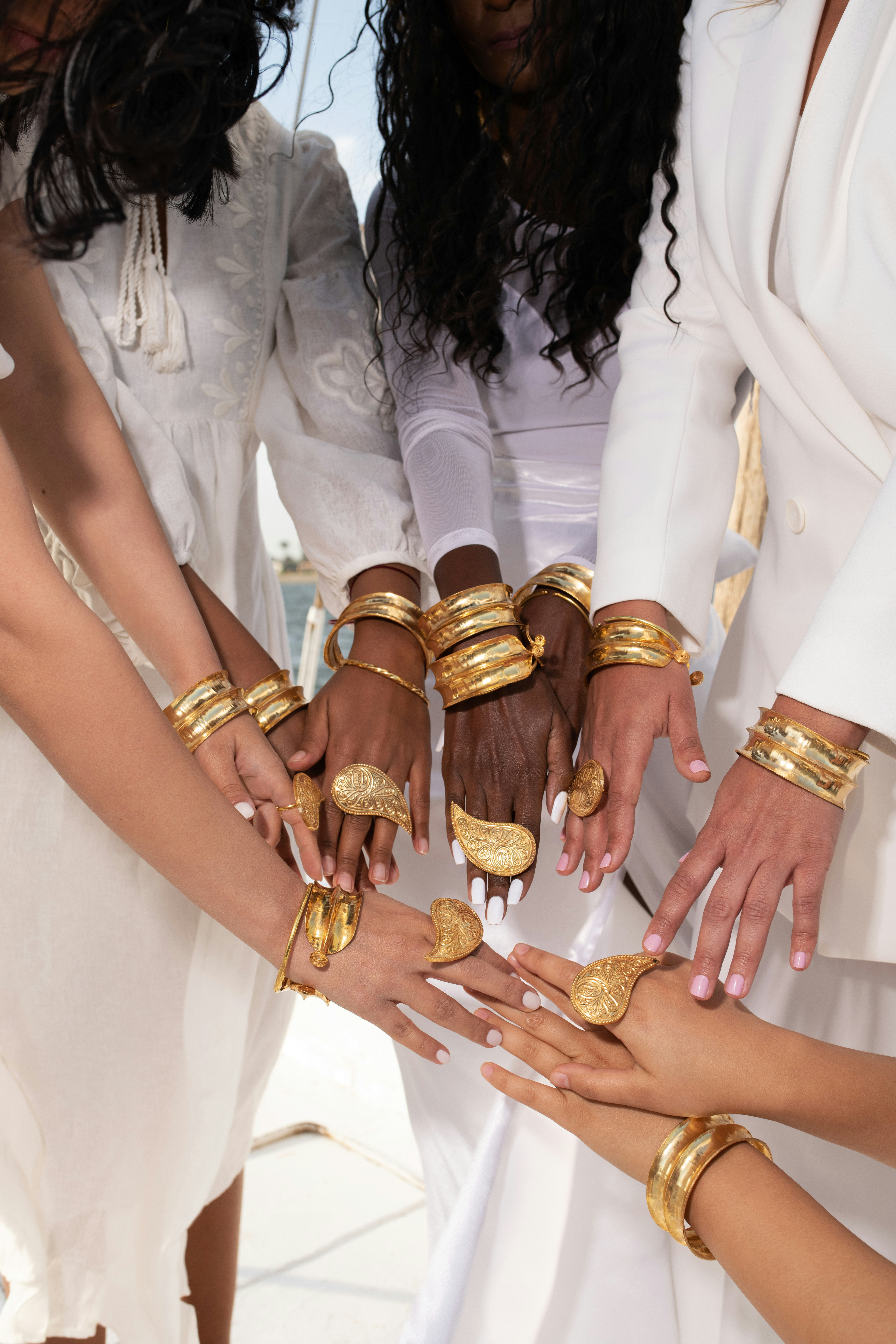
Anyone can walk into a store and buy something they like. The actual skill is what happens around it. A single piece exists in isolation. A look is a system. The ring means something different when it’s next to the right watch, layered with the right bracelet, paired with a necklace that shares its logic without matching it exactly. That coordination is where “curated” actually comes from, and it’s the gap between someone who owns nice jewelry and someone who looks like they have taste.
You get there one of two ways. You develop the eye over time, learning how pieces talk to each other, what proportions work on your frame, how to mix textures and metals without it looking like a drawer exploded on you. Or you buy the set: find a designer whose pieces are already built to work as a collection and let their eye do some of the work. If you’re just getting serious about fine jewelry, the set is the smarter starting point. It lets you look considered while you’re still training your eye, which takes time and honestly a few expensive mistakes. Most people with great style eventually do some of both. Either way, the assembled picture amplifies the signal in a way that no single piece can. That assembled quality is what actually registers when someone walks into a room.
The Shortcut
Forget “is this quiet luxury,” which is meaningless now. The question worth asking is where the money is actually going in a piece. Into the metal and stone and craft, or into the name on the box? Does the designer have a reason for the choices they made, or does this feel like an aesthetic accident that photographed well enough to sell?
At the price point where serious fine jewelry starts, you have enough leverage to get real answers to those questions. The independent tier of fine jewelry has expanded considerably in the last decade and produces some of the most considered work in the category. You just have to look slightly past the brands with the biggest ad budgets. The big houses often do extraordinary work, but the independents are where your dollar stretches furthest into actual materials and design, and where you’re most likely to find something that doesn’t look like everyone else’s.
Buy from people who can explain their choices. Not in marketing language. In material and craft language. Why this stone in this setting on this chain length. That explanation exists somewhere, either in how the brand talks about their work or in the piece itself. Find it.
The Middle Way
The fashion press has largely declared quiet luxury dead and maximalism its replacement. Sculptural gold, bold proportions, statement pieces, more is more. You’ll see it everywhere if you open a fashion magazine or scroll long enough. And it’s not wrong, exactly. There is a real aesthetic shift happening. The question is whether you care.
Most people with genuinely good style aren’t doing full minimalism or full maximalism. They’re rooted in classic, always-in-style foundations and they nudge upward from there when something actually interests them. A solid gold chain that’s maybe a little heavier than the safe recommendation. Studs a half-size bigger than expected. A ring with an interesting stone where you might have defaulted to a plain band. The base stays reliable. The edges move when you want them to.
That’s the position that survives because it doesn’t require anything to survive. You’re not reacting to what the fashion press says is happening this season or the next one. You’re building from what you know works, and the trend cycle becomes background noise instead of the whole game.
What Sticks
Quiet luxury as a phrase is probably finished. It’s been used too loosely for too long and the trend machine has already moved on. But the question it was getting at, what does this piece say and to whom, is worth asking every time you’re about to spend real money on something you plan to wear for years.
The best jewelry decisions sound like this: “I want this particular thing, made this way, that works with these other pieces I already own.” Getting to that level of clarity takes more work than any amount of shopping.
And if you’re building a collection rather than just accumulating pieces, the coordination matters more than any individual purchase. One perfect ring is great. One perfect ring that sits right next to everything else you own is where you’re trying to get. No trend label is going to do that work for you.
Get the edit.
New picks, styling ideas, and honest reviews — straight to your inbox. No fluff. No spam.